
Regenerative Blowers
Single-Stage and Dual-Stage Regenerative Blowers
Operating Principles: The impeller rotates inside the blower housing, pulling air in through the inlet, or vacuum side. The impeller then accelerates the air or gas inside the housing until it is fully pressurized, and discharges it through the exhaust outlet, or pressure side.
Single-Stage blowers are the most common type of Regenerative Blower; with these blowers, air travels around the internal air channel once and is then exhausted out to the application. Dual-Stage Regenerative Blowers can provide a lot more pressure or vacuum than their single-stage counterparts because the airflow is channeled back around the impeller for a second rotation before being exhausted. This causes the air to be more laminar which greatly increases the velocity pressure of the conveyed air.
What about maintenance? The motor shaft is the only moving part, which spins the impeller directly; it does not come in contact with the housing at all and is, therefore, “wear-free”. Pre-lubricated bearings are the only wearing parts, and these days, bearings have some of the lowest failure rates of any mechanical item in existence.
View Product List
Find what you need.
Regenerative Blower Applications and Uses
Regenerative Blowers have many different uses throughout the industrial world.
Here are just a few:
- Wastewater Treatment Aeration
- Tank Aeration (Fish Pond Aeration)
- Pneumatic Transport of Powders and Solids
- Landfill Gas Evacuation and Collection
- Groundwater Sparging
- Air Knife Drying and Blow-Off
- Soil Vapor Extraction
- Vacuum Lifting
- Gasoline Vapor Recovery
- Vacuum Hold Down
- Lagoon Gas Recovery
- General Parts Drying
- Material Handling/Conveying
Regenerative Blower vs Air Compressor
You will typically see a savings of 90% or more in running costs between a Regenerative Blower and a compressor.
So, why is a Regenerative Blower so much less costly to run than a compressor? The answer is found if we dig a little bit deeper into the different fundamental operating principles of how these 2 machines work.
It takes energy to compress air, the higher the pressure-demand is, the more energy required.
An air compressor functions by compacting atmospheric air into a tank and then relies upon releasing that air out of a very small nozzle at high velocity to perform the task at hand. The problem with this is that regardless of what pressure your application demands, a compressor is always going compress the air up to a certain PSI.
A Regenerative Blower, on the other hand, only pushes against the load that it is given. If you put 1PSI of resistance against the blower, it will only produce 1PSI of pressure, even if it has the capability of producing 10PSI. This means that when you use a blower, it will only take what it needs rather than target a very high pressure irrespective of the application needs.
Applications

Air Knife Drying / Air Knife Blowoff
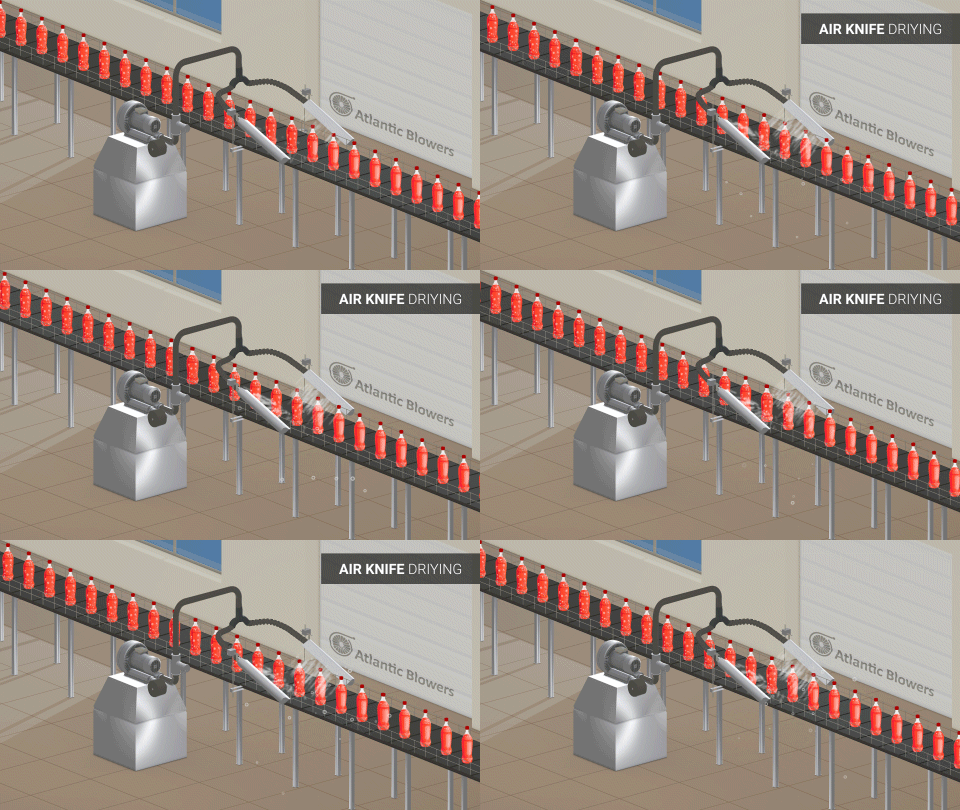
An air knife system is meant to blow off any remaining substance (such as dust, water or any other liquid or debris) from products on a conveyor. These products have typically been washed or have been dipped in a liquid that needs to be dried for packaging. This is where an air agitation blower comes into play. As the product moves down the conveyor it passes through the airstream to be dried.

Waste Water Treatment / Tank Aeration
Microorganisms in an aquatic system require oxygen to breakdown waste material. This process is just one step in waste water treatment that ultimately results in a clean water source. When using our Regenerative Blowers and diffusers for aeration, we can assure maximum oxygen transfer efficiency in any waste water system.
Request a Regenerative Blower Catalog
What to Expect
Thank you for considering Atlantic Blowers Regenerative Blowers for your application needs. Please fill out the form to the right to receive our Regenerative Blower Catalog. Enclosed in the catalog you will find a lot of information about our entire line of Regenerative Blowers. Everything from performance curves & dimensional data, to applications & uses is covered. If you have additional questions or need more detailed information, we also have spec sheets available for each individual blower.
Our catalogs contain general information, such as features and benefits of our products and specific innovations within the Atlantic Blowers line. You will also find performance data tables and performance curves for all models to quickly find the correct product for your application. Also included is dimensional information so you can easily plan ahead for your product arriving at your facility.